DIY Ceiling Fan Upgrade

Hi All! Does this happen to anyone else: You see an idea that is so insanely easy that you just can't waste a second to try it yourself? This was me right after this post featuring Jen's bedroom and foyer Reader Design. She solved a simple issue in her bedroom which I'd been scratching my head about with our own.

The dated ceiling fan light fixture! I see so many gorgeous room makeovers where the ceiling fan is replaced by a stunning chandelier or pendant, but getting rid of our fan was not a suitable option for us. We may have still been getting snow into the middle of March, but Virginia summers are brutally humid with long stretches over 100 degrees. So, what to do about those intrusive tri-light foggy glass shades that no-one invited to the party?

How about add a drum shade!

I've been wanting to add a drum shade to this fan for quite some time, but it was one of those ideas that just wasn't at the top of my priority list as I figured it would require a decent chunk of time. Boy, was I wrong! I happened to click over to Jen's drum shade tutorial, and when I discovered this project would take me a quarter the amount of time it takes me to get all three of my kids out the door in the winter time, I didn't waste a second giving it a go!

The pictures below show what you'll be working with. See that screw cover which the pull chain is hanging from? That's the secret key! Start by unscrewing that, (and remove the foggy glass light shades).
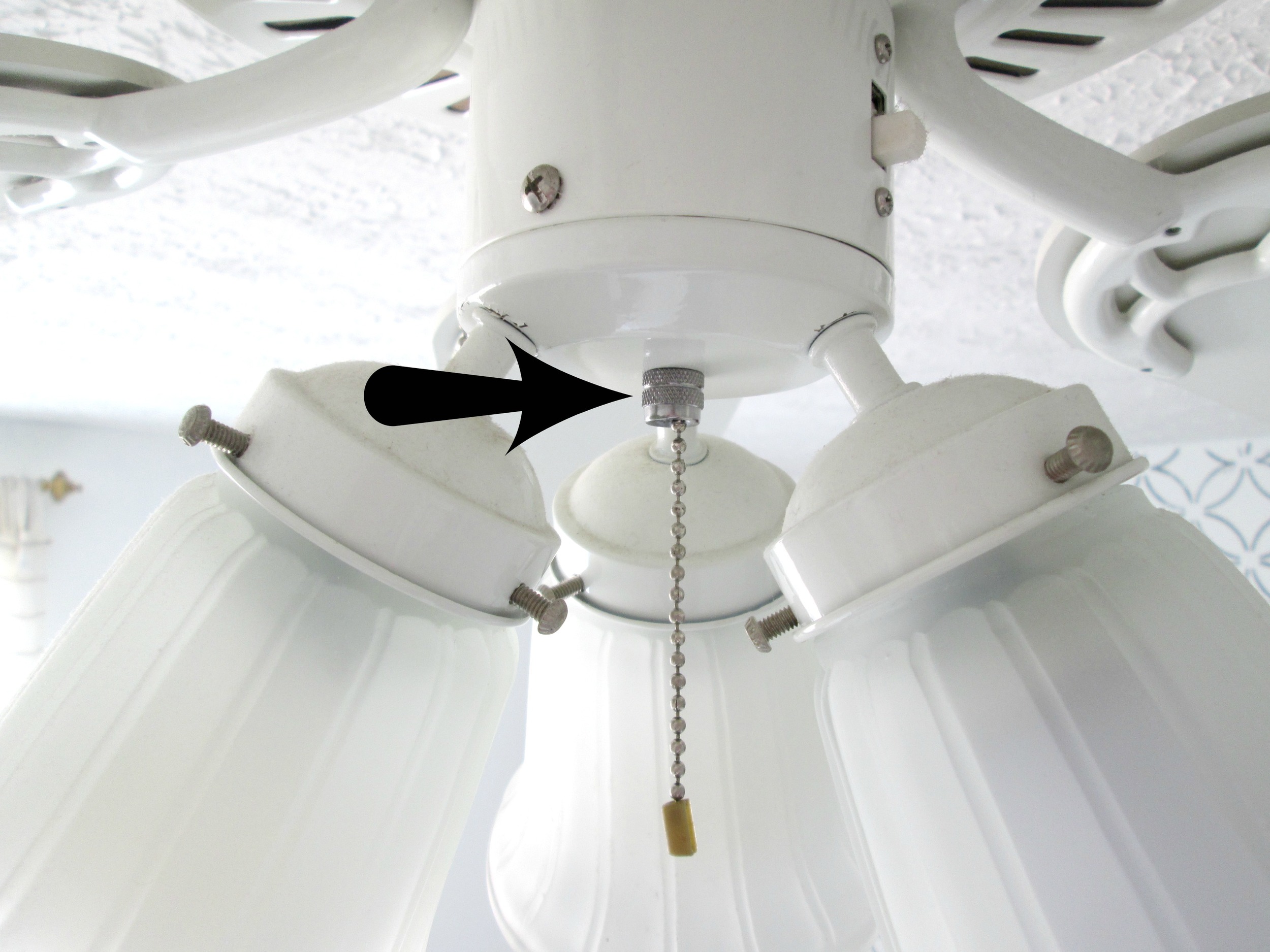
Now, this is where my experience with this upgrade differs from Jen's. The center of her drum shade fit perfectly around the nipple, and she was able to then just reattach the cover from under the drum shade to keep the shade in place. Unfortunately, the center of my drum shade was much thicker than the nipple and there was nothing exposed to thread the cover onto. This was the quick fix:

Purchase a nipple and coupling from the hardware store, (the best option I found was a multi-pack of different sized nipples and it was only a few bucks). In the picture below, the coupling is on top, and the nipple is below, (for anyone who hasn't worked with these materials before).

fan light1.jpg

Screw the coupling onto the nipple emerging from the fan.

fan light2.jpg

Then screw one of your purchased nipples into the coupling. The size shown below ended up being too long so I used the next size down in my pack.

fan light3.jpg

Then lift your drum shade up and into the center of the nipple, and hold in place with an appropriately sized washer. I ended up adding a second nipple underneath just because I had an extra one in the pack I had, but a washer on its own will do the trick.

fan light4.jpg

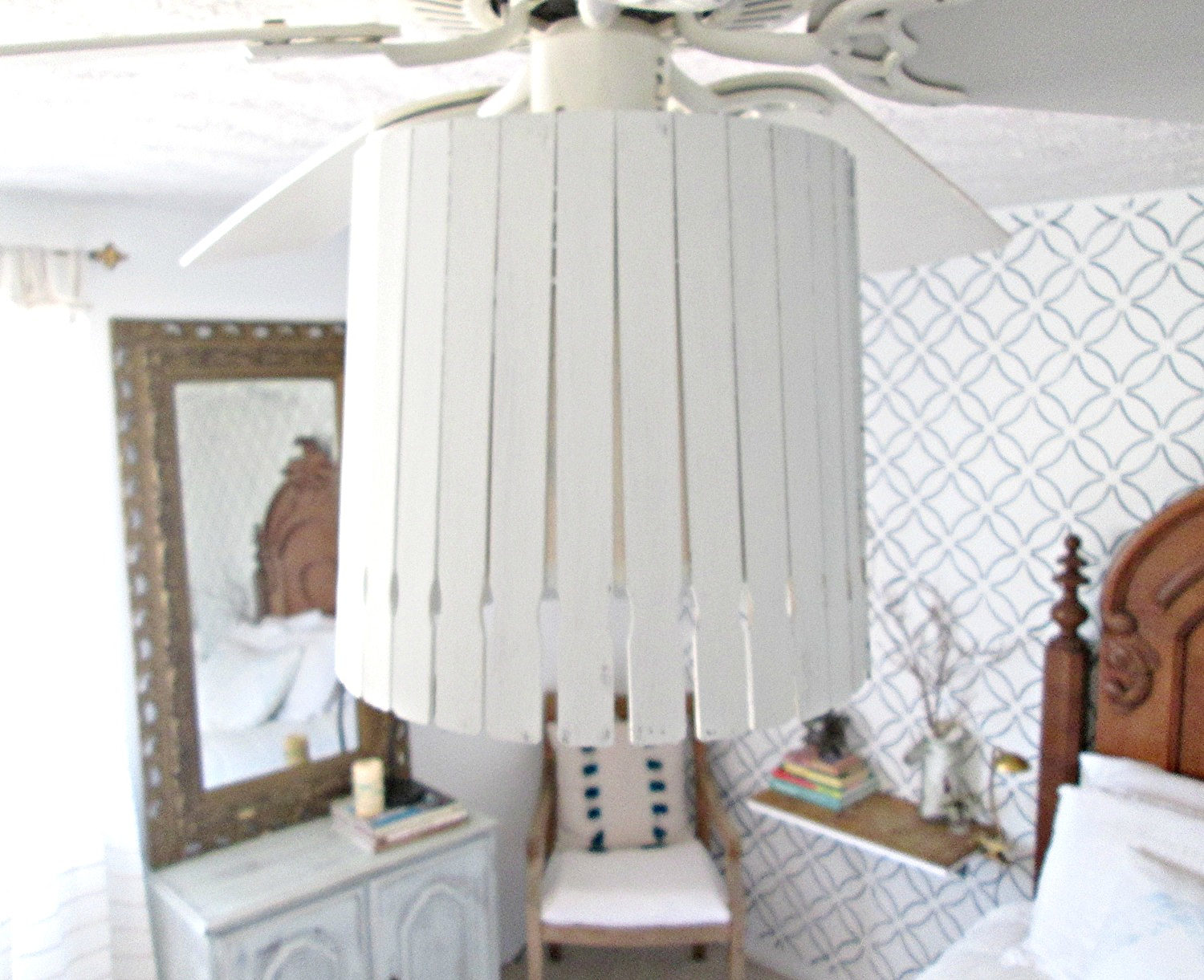
Don't you just love when the ratio of time put into a project vs it's impact is like 1:4312343!?

done5.jpg

Easy-peasy! Oh! And just FYI - I used a DIY paint stick lampshade for this project.

Thank you all for stopping by!



Reader Design: Cate's Color-Clad Loft

I'm doing my Friday dance extra hard today because I get to share an extra special Reader Design - Cate's!!! Cate is actually moving today out of her and my brother's first apartment together. They moved in over a year ago after their wedding, and while it's on the small side, I absolutely adored everything they, (Cate), turned it into. 

It seems that it's a right of passage for your first place to be sub par, am I right? Do you remember your first place when you were just starting out and were supposed to have the world at your fingertips? Was it tiny and infested with vermin? Did you have to drag your groceries up three floors of stairs? Does anyone actually remember their first place and miss it?! And yet, that first place will always hold a sentimental place in your heart.

In honor of that sentimental place, I asked Cate if she'd mind me featuring their first apartment, (a studio loft), as our Reader Design today. It hasn't been the easiest place for them to live, but I know you all will be absolutely amazed at what she did with it!

Living Room

From Cate:

"We are very proud of our newlywed nest;  I'm proud that I managed to make my extensive collection of roadside rescue furniture and DIY decor work for a small space.  And Caleb is proud that he found us an apartment that, although minuscule, still has more than one bathroom {1.5 to be exact} and a flight of stairs.

We have our extra storage in this faux-front apothecary chest from Kirklands.  Above it hangs another engineer print that was converted to a faux pull-down chart, (tutorial here)."

"On our walls hang some original artwork - two acrylic paintings and one art piece made using a photo-to-canvas transfer method from A Beautiful Mess. Suitcases on the wall provide extra hidden storage."

"Extra credit if you spotted the roadside rescue from Chelsea's suitcase table post!"

Yes, we often want eachothers' flips. :)

"Behind the floating sofa is an old metal file cabinet that I spray painted aqua.  It provides a great place to hold all my tools since we don't have a garage. Head up the stairs and you'll find the remnants of an old church pew from my childhood church in DC."

Not a typical first place, is it?! With singing colors at every angle and clever ideas from floor to ceiling, this is one of my favorite inspirational spaces. Just wait until you see the upstairs...

Bedroom

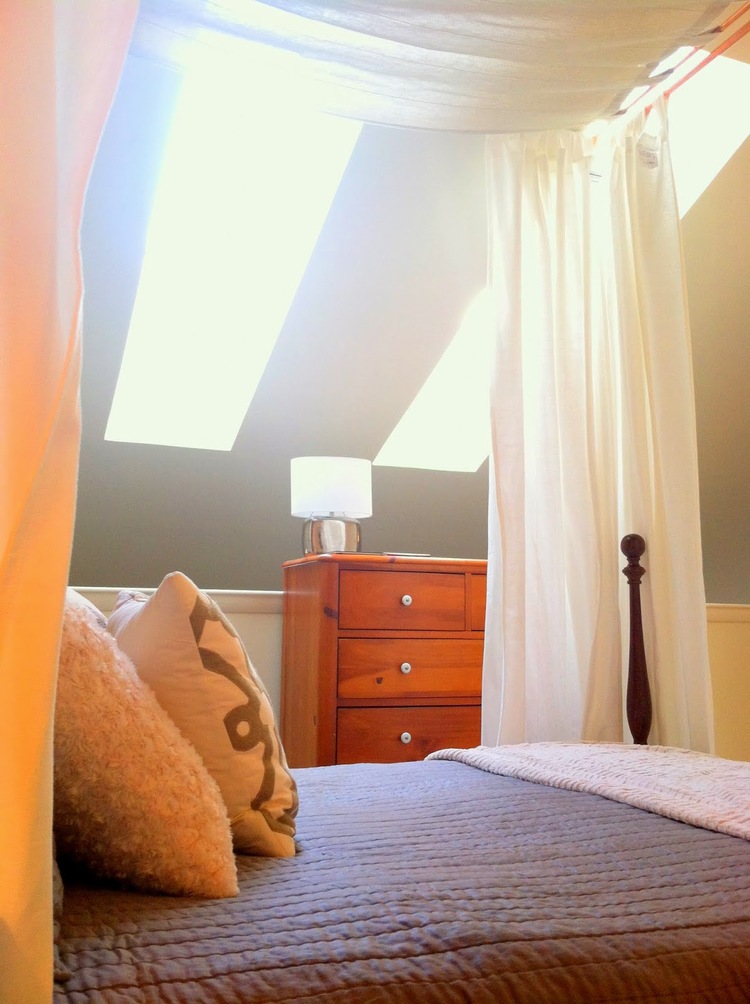
"Our bedroom is small and comes with some {BRIGHT} skylights.  After extensively researching my options for how to keep such strong sun out so that Caleb could sleep in, I decided on building a ceiling canopy around our bed.  The curtains are hung from a rectangular frame made from copper pipe and pipe fittings from Home Depot.  There are two curtain panels for the "headboard", one for the top canopy, and 3 pairs {6 total} for the remaining 3 sides."
 

I know. It's so gorgeous I can't get over it.

Hello, sun!! No wonder Cate had to come up with a solution to block those skylights!

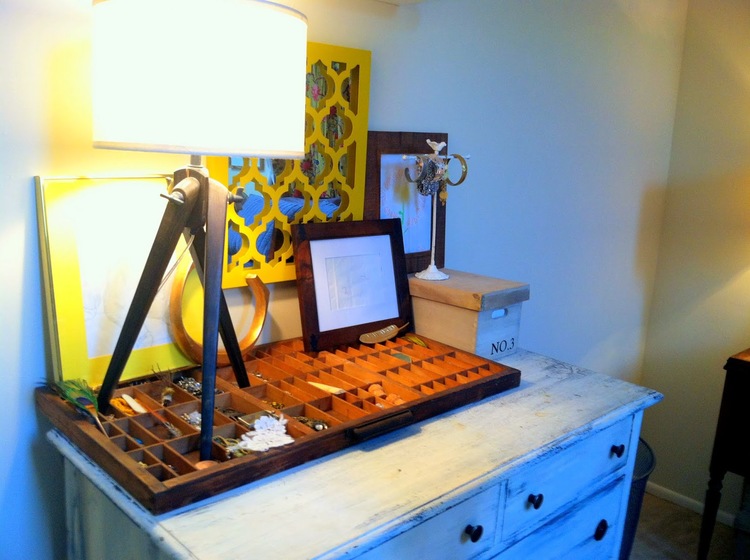
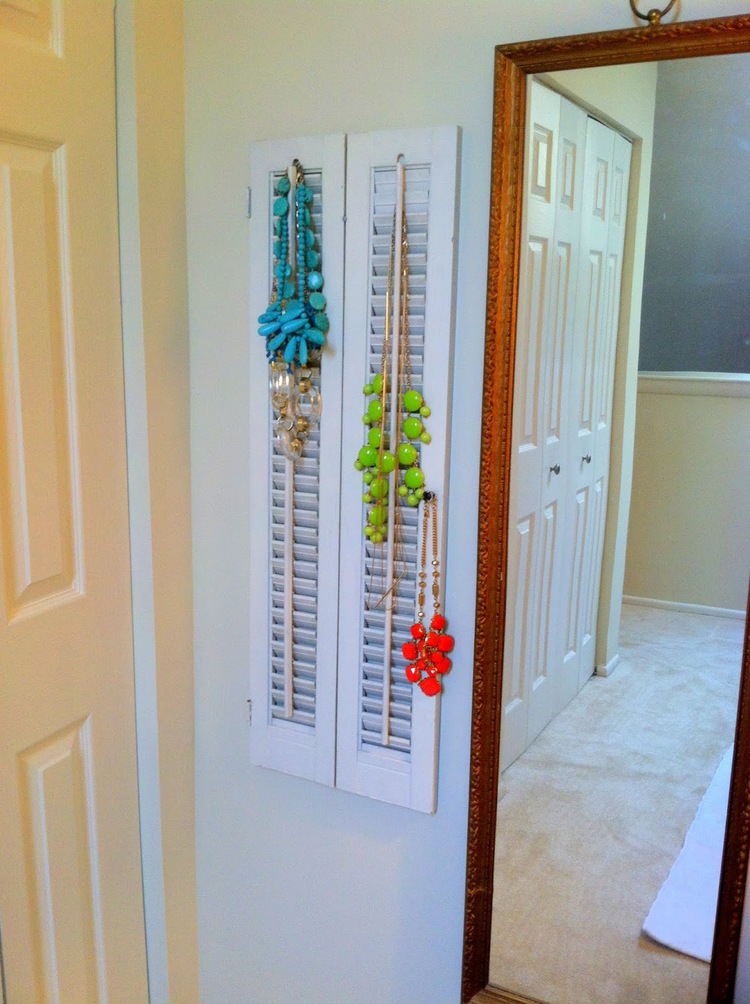
Check this post for more of Cate's creative ideas for organizing and displaying jewelry!

Let's see one more of that stunning living room:

Consider my inspiration tank FULL! Cate, thank you so much for letting me share this today. It's such a treat to get to work along side of you and be inspired by your passion for creating. You are such a blessing to me! Definitely looking forward to where God takes you and what you make of it in your next place! You can follow Cate's adventures on Instagram @cate_stylemutthome

Don't forget to submit your own spaces so we can share your work and creativity here! You can post right to our Facebook page, or tag #stylemuttspaces on Instagram. Every Friday we share one new Reader Design - there's no requirement to be a professional decorator or even a fellow blogger. The whole point is to share inspiration with one another and keep it all in one handy spot; our SPACES page, (I could seriously kill a whole afternoon thumbing through the gorgeous tours we've got stashed in there). 

Have a wonderful weekend and Happy Easter, everyone! He is risen!


DIY Tree Stump Tables - ||Full Tutorial||

You guys, Cate and I have been working on a little side project that we are so close to finally being able to reveal! It's our first full design job and we lucked out with the sweetest young client who just moved into an apartment in Washington D.C. Aside from her bed, a sofa and a chair, we are starting from scratch. We are at the point now where most of her large pieces are done and we're moving into the fun decorating stage! 

Our client is an eclectic gal who appreciates various design styles, (so up our alley), and when she mentioned a desire to include some rustic elements in her decor, our minds jumped right to tree stump end tables, (yes, Cate and I have this weird thing going on where we often think of the same thing at the same time. It's both cooky and awesome).

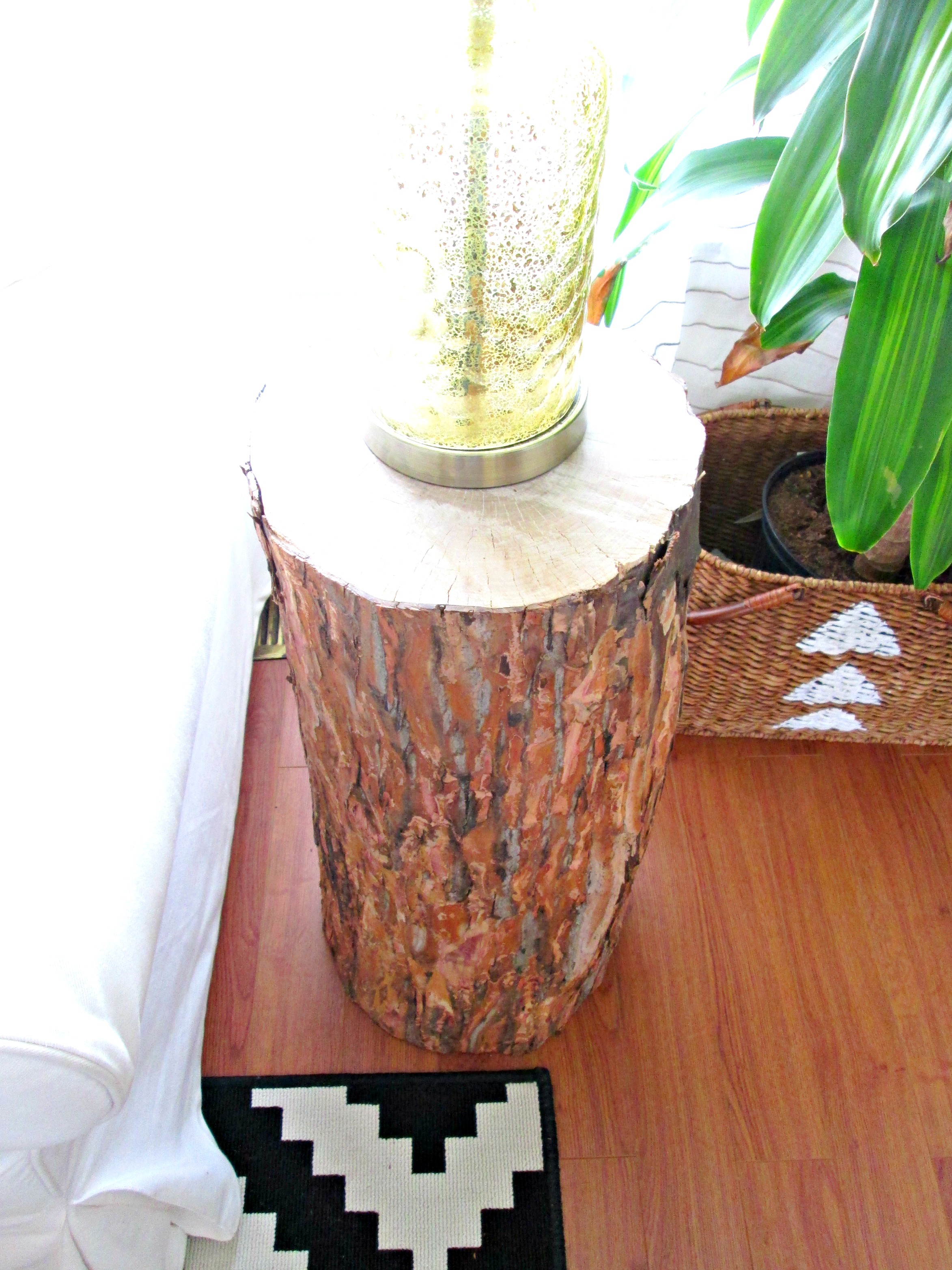
I took a few shots of one of the finished stump tables in my home to show you since we're banking suspense for a full reveal post of this secret apartment. ;)

This seemed like a quick and easy project, but once we got rolling there were a few more logistics to consider. Hopefully this information is helpful to anyone out there who wants to try this so it really is a quick and easy project for them!

The first consideration was which type of wood to use. Oak and Maple are both popular trees in our area, but with Oak being so heavy, we decided Maple would be a better option, (we're strong girls, but our client is in a second floor apartment with no elevator, so....). When we found a tree cutting service taking down some Maples in my neighborhood we hit the jackpot! They were willing to give us what wood we needed for free and even offered to cut the specific size we needed, which was 24", (although for some reason they cut us two 48" sizes, so in the end we had to cut them ourselves anyways).

The next task was bringing the stumps inside to dry out, (by inside, I mean a garage or some covered area that's not your house). This is important as it will make the next stage, (stripping the bark), a little easier, and also help get rid of any critters under the bark.

Here's what one of the stumps looked like before leveling off the surface and stripping the bark. We used a miter saw to shave off the top surface to get it more level, (thanks for taking that on, Matt).

After a week or so of drying out the sumps, it was time to remove the bark! Cool as the bark looked on the stump, we wanted to warm the stumps up a bit and remove the cool grey toned bark. Also, not to deter anyone, but there are things that live in bark, so removing it will ensure a bug-free stump table. ;) 

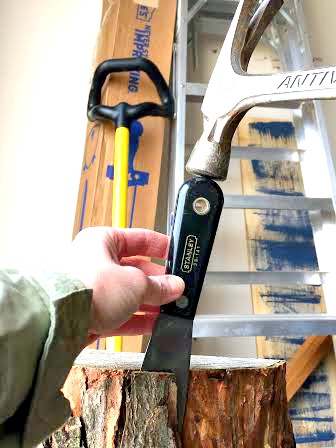
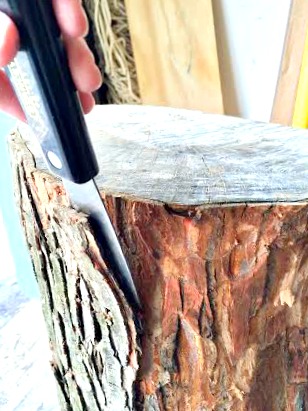
To remove the bark I used a spackle knife and hammer. I'd pry the spackle knife under the bark a bit, and then tap the hammer on the spackle knife handle to pull the bark up. Then I could just lift the bark off easy peasy.

Here is the difference between a bark and de-barked finish. Love the multi-toned warmer colors of the wood underneath the cool grey bark!

After all the bark is stripped and the top surface is sanded smooth, (I used a rough, 100 grit sandpaper followed by a fine 220 grit paper to get the top surface really smooth to the touch), it's time to seal! I sealed the entire stumps, top surface as well as up and down the sides, with Minwax Polyurethane Sealer.

And bodda-bing! You've got rustic end tables! 

We are so excited to share these tables in the context of the apartment we're working on! Soon, baby, soon. If you happen to try this project yourself, please promise you'll share with the rest of us! We love seeing and showing off your creativity and handiwork , (just post photos of your projects to our Facebook page). 

And don't feel confined to end tables - another idea for tree stumps is using them as stools - I used a chunk that we needed to cut off from the original 48" stumps to use as a little stool under our industrial shelves. It's the perfect height!

pipe shelves after1.jpg

Thank you so much for stopping by!